Feeds:
Posts
Comments

And so this is Christmas, and what have you done? Another year over, a new one just begun.

 Although Christmas is behind us, John Lennon’s lyrics are still apropos – this is the ideal time for reflecting on the years of our lives, past and present. It’s Wednesday, midway between Christmas and New Year’s, and I’m gazing out my window at a windy gray day that looks much like November. I’m feeling suspended in limbo, wondering how to spend these last four days of 2011. Should I try to be wildly productive, or should I just wallow in self-indulgence and resolve to be more proactive in 2012?

I don’t know about you, but I can’t help making resolutions during the darkest days of the year. They’re generally much the same  – exercise more, eat better, lose weight, get organized, stop procrastinating, throw stuff out, write a new novel. Oh yes, and stop playing computer games. I usually make only marginal progress, but there’s always the hope that next year will be better.

Today I lazed around in bed till noon, reading a book about procrastination – what causes it and how to overcome it. I picked it up at a library book sale last spring, but I’ve procrastinated about reading it till now. Will it help? I realize that’s pretty much up to me. Back in high school, I remember making the resolution, “Stop being a procrastinating perfectionist.” I’ve long since stopped being a perfectionist, but the procrastinating part definitely still applies.

A new resolution I’m adding can be summed up in one word – gratitude. Yes, it’s discussed in lots of self-help books, and my Nia teacher frequently ends class by having us focus on all we have to be grateful for, especially the people who are most important in our lives. Many writers have suggested reviewing and maybe writing down the things we’re grateful for at the end of each day. It’s something I haven’t done enough of, but this coming year I plan to take it more seriously.

Above all, I’m grateful for my beautiful and wonderful family – my husband, my daughter Stacey, and my two wonderful granddaughters, Kaya and Jasper. I can’t resist posting the beautiful photos my daughter took of the girls. I gave them the fairy wings they’re wearing in the Christmas photo, and their other grandmother gifted Kaya with the cello, which she’s been playing for a couple of years. Doesn’t she look every inch the brooding artist? It runs in the family, I guess.

I’m also grateful to have had the wherewithal to buy them a reasonable number of gifts, though we didn’t go overboard. Nor did we use our credit cards. But my checking account was pretty well tapped out, and I’m grateful for the Social Security payment that showed up in my balance last night. With grandchildren, it’s truly more blessed to give than to receive, but I’m looking forward to going to the mall momentarily to take in a movie – Sherlock Holmes, maybe? – and to indulge myself in a couple of gifts for moi, as Miss Piggy would say.

Here’s wishing you a wonderful New Year. May you have much to be grateful for.

Van Gogh's Night Cafe

National Novel Writing Month will be over in exactly 24 hours, and I’ve only got 48,000 words. The finish line is in sight, and by midnight tomorrow I’ll have to crank out at least 2000 more. I’m determined to do it, even if I have to pull an all-nighter the way I did for college term papers.

I hope the NaNoWriMo  administrators never read this blog post, because I’ve got a confession to make – I cheated a little. At about 35,000 words, like a marathoner, I hit a wall, and I knew I’d never make it at the rate I was going, so I copied a few online articles relevant to my research and pasted them into my document. Methods of suicide, assisted dying and state laws about same – fun stuff like that. Only a few thousand words, but enough to help me over what would otherwise have been a hopeless hurdle.

Even so, I’m proud to say that about ninety percent of the words are mine, all mine. Of those, I hope more than half are the actual first draft of my new novel. Those I’ve been formatting in traditional black type, double spaced. But they’re interspersed with miscellaneous meanderings. Many are about the developing plot and the evolving characters. I type those in single-spaced red. Green is for personal ramblings that have little to do with the novel – except that often they lead to new ideas for my fictional tale. And purple is for blog posts like this one, which I’m also copying and pasting into one enormous, unwieldy document.

I’m writing scenes about whatever captures my fancy at any given time, without worrying about where they may eventually end up in the book. Which point of view I pick depends on my mood – sometimes it’s Paula Rhodes, the temperamental CEO of Compassionate Care, the home care agency inspired by ElderSource, Inc., which I ran in the 1990’s. Sometimes I’m drawn more to Claire Lindstrom, the idealistic nurse who was my main protagonist in Eldercide. And then there’s the evolving character of Carolyn, who assisted at the death of her husband, who was suffering from the end stages of pancreatic cancer.

Edvard Munch - The Scream

My printer may have died, but I don’t have time to diagnose what the problem is and whether it’s fixable or I need to buy a new one. So I don’t yet have a hard copy to work with, nor have I reread most of what I’ve written. Sometimes I scroll back to read the last scene in order to hazard a guess as to what comes next, but by and large I’ve managed to banish my inner critic.

When December arrives, I’ll do a “save as” and begin dividing this humungous document into manageable sections. Then I’ll see what I’ve come up with and where I go from here. At that point I’ll have the luxury of slowing down and maybe letting that inner critic to have her say.

Though I’ve written four novels and published two of them, I’ve never worked this way before, but I’m enjoying it. Most importantly, the NaNoWriMo challenge has inspired me to barrel through the creative block that plagued me for so long, to get back to my writing, and to discover that my muse hasn’t deserted me after all.


As I was agonizing over the plot of my new novel today, I took my customary two p.m.break to watch my favorite soap opera, One Life to Live, and it got me thinking about the recurring themes and conventions that drive the multiple story lines.

Some of these plot devices are so unrealistic and/or overused that they’d be unbelievable if used in a novel. But if the story line is engrossing enough, it’s possible to suspend disbelief.

Here are a few that come to mind about the denizens of Llanview, Pennsylvania:

  • People rarely phone ahead, preferring to drop in unannounced on the folks they want to talk to. Occasionally they knock, but they never wait for someone to open the door; they simply barge in.
  •  Invariably these visits interrupt something critically important: someone is about to confide a long suppressed secret or declare undying love, or a couple is discovered in bed, whether before, during or after sex. Sometimes the discovery results in a plot twist, but usually it’s just an excuse to extend the same theme for days, weeks or months without resolution.
  •  Comas and amnesia are amazingly common.
  •  People do a great deal of eavesdropping. This is a piece of cake, because the characters frequently deliver confidential tidbits in a normal tone of voice and in public places – bars, restaurants, hospital corridors, airports.
  •  People long thought to be dead come miraculously back to life. When a new actor is cast, the altered appearance is sometimes attributed to plastic surgery.
  •  Even when just getting out of bed, everyone is impeccably groomed, and like Warren Zevon’s Werewolves of London, their hair is perfect.
  •  Men spend a lot of time parading around with their shirts off – at least the guys who have six-pack abs and obviously spend a lot of time at the gym. Their bodies are usually waxed and hairless. Those less fit or hairier have the good sense to keep their shirts on. Women stay relatively covered up, perhaps to avoid provoking jealousy in the primarily female audience.
  •  Men fall in love quickly and easily, are amazingly eager to get married and invest a great deal of emotional energy in fatherhood and questions of paternity. Currently, Brody Lovett (seen below) has kidnapped a baby that’s not even his, while John McBain (seen above), the true father, is in hot pursuit.
  •  People get married multiple times, often three or more times to the same person. But many wedding ceremonies are torpedoed by someone with a grudge to settle or a major plot twist to reveal just before the point of “I Do.”
  •  Many characters have high-level professions (mayor, newspaper editor/publisher, CEO of  a billion-dollar company) but are rarely or never seen at work. Police are an exception, since their work is more dramatic and impacts more directly on the unfolding plots. In addition to their primary professions, an amazing number own bars or restaurants, while those less fortunate wait tables or tend bar.
  •  The citizens of Llanview spend a great deal of time in said bars and restaurants, even in the middle of the day. Many secrets are spilled, and confrontations are frequent.

Speaking of bars and restaurants, it’s after five, and my interior clock tells me it’s time for a libation. No doubt I could come up with many more soap clichés – or perhaps you can add some of your own.

Sadly, ABC is canceling One Life to Live after a run of more than 40 years, and some of the featured actors have been around for almost that long. The network cites rising production costs, falling ratings, and changing viewers’ tastes as the reasons, and the last new show will be aired in January. OLTL’s hour slot will be filled by a show on health subjects, no doubt with a panel of obnoxiously cheery co-hosts along the lines of The View and The Chew, so I’ll be able to reclaim the hour that interrupts my creative flow just at my most productive time of day. (Yes, I could watch it at 9am or 9pm on the Soap Channel, but when there’s a real cliff hanger, I like to watch it ASAP.)

But all is not lost – a company by the name of Prospect Park plans to launch a new “Online Network” in January. They’ll feature all-new episodes, and reportedly many of the current actors have already signed contracts with them, including my favorite, Michael Easton, who plays John McBain.

By the way, my NaNoWriMo novel is coming along well. I’ve now passed the midpoint of 25,000 words, but I’m a couple of days behind. Stay tuned . . .


This morning I rendezvoused with three other NaNoWriMo authors for an early lunch at Brueggers Bakery in Albany. They’re decades younger than me, and all three have completed the challenge of writing 50,000 words in one month several times already. But to my amazement, none of them are particularly concerned about getting published – the pleasure and challenge of writing are evidently enough for them, at least for now.

These young women reminded me of why I started writing fiction in the first place – not to become a published author, let alone a successful one, but because I had things to say that I simply had to get down on paper, even if no one else ever read them. If I recover some of that innocent enthusiasm this month, NaNoWriMo will have been well worth while. More than a third of the month is over, and I’ve turned out 18,000 words. That averages out to around 1,500 words a day and keeps me on track to finish on time, but just barely. The NaNo website features occasional pep talks by fellow writers. The first was from Erin Morgenstern, author of The Night Circus, which is currently on the New York Times Best Seller List. She describes how the novel had its genesis during NaNoWriMo as a spin-off from the novel she’d set out to write. Water for Elephants also began as a NaNoWriMo project.

Maybe there’s truly some magic about circuses – they certainly spelled success for those two authors. Circuses don’t figure in my new novel, at least not yet, but who knows, maybe they will. Perhaps one of the elderly clients of Compassionate Care will be passionate about the circus, the way my father was; one of the greatest thrills of his life was riding atop an elephant down Wisconsin Avenue when Ringling Brothers, Barnum and Bailey came to Milwaukee in the 1960’s. Not a bad obsession to help illuminate one of my characters, and the idea came to me just now.

I’m one of those writers whose ideas flow most freely and unexpectedly when I’m typing at my computer. I know I’m on the right track when my characters start saying and doing the unexpected, and when they pop unexpectedly into my head at all times of the day and night. But I don’t talk about them or about my evolving story line with other writers – I find that dissipates the energy. The sole exception is my husband, who comes up with brilliant plot ideas on the fly whenever we talk about my book.

So I’m drawing inspiration from two extremes on the continuum of the writing life. At one end are the ingénues, who write for the sheer pleasure of the process, and at the other extreme are those who’ve made it onto the best seller lists. For now, I’m happy to be somewhere in the middle.

I’m signing off for now, eager to get back to Paula and Claire at the Compassionate Care home care agency in the fictional town of Cooperskill in upstate New York. But I’ll post here again soon. Meanwhile, I’d love to hear from you!

Today’s my sixth day of National Novel Writing Month. I started out with a bang and churned out a lot of words on the first three days, then goofed off and fell behind. NaNo has a nifty bar graph that charts my progress, telling me exactly how many words I need to turn out per day to finish in time and how long it’ll take me at my present rate.

Today NaNo says I’ll finish on December 8th, so I’ve got to pick up the pace. This is about the point I copped out the last time I tried several years ago, but I’m determined to stay the course. Fortunately my husband is understanding and supportive – he’s entered NaNo too. Right now I’ve got about twice as many words as he does, but he started late, and I expect he’ll pass me before too long.

I’m all too easily distracted. It’s a beautiful sunny Sunday afternoon, perfect for leaf raking and putting the garden to bed, but I don’t dare go outside until I’ve written at least a thousand words. From my office window I have a bird’s eye view of my next-door neighbor’s roof. Two men are laying down new roofing, and it’s a pleasure to watch them, especially the younger one who’s wearing a black tee shirt and jeans as he crawls around with amazing agility. I’m admiring his musculature while I study their technique.

He’s working incredibly fast, while the older guy mostly stands and watches, hitching up his pants every once in awhile. This side show would be all well and good except for the fact that he’s using an electric hammer which emits a steady rhythm of “ribbet, ribbet,” conjuring up images of frogs. I’m tempted to give the men a neighborly shout-out of encouragement, but that would destroy my voyeur status.

Everything’s grist for the mill. I won’t be able to use this scene just yet, because my novel takes place in January, but maybe my observations will come in handy for a future book, so it’s good to take notes. They’ll end up in my 50,000 word count, and so will my thoughts as I worked in the garden yesterday.

Picasso's Woman in Mirror

But there are some observations I can use immediately. Yesterday I went to a vegan restaurant in Troy in hopes of meeting some other NaNo writers who’d said they’d probably be there. I met only one, but I ended up in a long conversation with a non-Nano woman who was unusually talkative and forthcoming with personal information, like the details of her incontinence problems. Only after I showed her a copy of my book MOOD SWING: THE BIPOLAR MURDERS did she reveal that she was diagnosed bipolar. She said she’s doing fine without medication and by adhering to a strictly vegan diet. 

After I extricated myself from the conversation and left the restaurant, a light bulb flashed and I realized she’d make a perfect character for my book – maybe a ditzy secretary who drives the other staff crazy with her never ending self-referential chatter. I’ll transform her in most respects, of course – I don’t even how what she looks like yet – but I can envision her as a recurring character who adds some levity, like the grandmother in Janet Evanovich’s books.

Although I vowed not to get hung up on editing for this first draft, I find I can’t resist the urge to tinker with my words, at least a little. Yes, it slows me down, but I need to feel good about what I write. If I fall further behind, I’ll just have to put in more hours. And when I’m really feeling panicked, I can always paste in a short story I never published, but which I was planning to incorporate in this novel anyway.

Throughout the time I’ve been writing this post, those guys have been working nonstop on the roof. On this first day back on standard time, darkness will come all too quickly, but right now the sinking sun is throwing the young man’s face and arms into high relief. The pine trees framing the lake make a perfect backdrop, and on the opposite shore, there’s still lots of gold and red in the trees. All in all a beautiful sight.

So far, the biggest win for me in NaNoWriMo is the revelation that I can still write fiction, maybe at a higher level than I ever have before. In the year of depression from which I’m only now emerging, I’d seriously questioned whether I had another novel in me. Now I know I do.

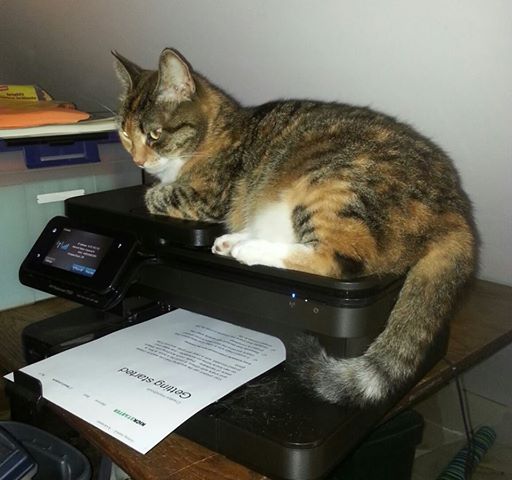
*I found the cat photo above by Googling NaNoWriMo, and I don’t know what’s up with the spelling. But she does remind me somewhat of my tabby cat Lunesta, who is currently sitting atop the computer monitor batting intermittently at the screen. She’s still on daylight savings time, not having realized we’ve gone an hour backward, and thinks it’s time for her evening meal.


This is the first sentence of my new 50,000 word novel. Yes, I’ve signed on for the exercise in masochism known as National Novel Writing Month. That big a word count averages out to 1,666 words a day, according to the site’s organizers, or about six and a half pages. That’s not an impossible goal on a good day, but I’ve never cranked out a novel that fast. Now that the race is on, my anxiety is already kicking in – I’m hyperventilating and my heart rate is rising.

NaNoWriMo (www.NaNo.WriMo.org) was launched in 1999, and it’s grown steadily since then. Last year 200,000 people participated, and of that number, 30,000 completed 50,000 words or more. Those who reach the finish line get some kind of sticker and certificate. There’s no fee to enter, and no one sees or reads the finished manuscript. When you reach 50,000 words, you upload your novel to their web site to verify the word count. If you’re paranoid, you can do a “save-as” and scramble the book a bit to insure that no one can steal your plot.

So why did I make the first line of this blog the novel’s first sentence? Because I plan to make my 50,000-word manuscript a form of performance art in order to beef up my word count and blend fact with fiction. I’ll alternate fictional scenes with stream-of-consciousness ramblings about my creative process, some of which will end up on this blog. Who knows, the process may open up new horizons for me as a writer.

I entered NaNoWriMo several years ago but dropped out after a week because the break-neck speed made me excruciatingly nervous. As a writer, I’m accustomed to taking my time, backtracking and editing as I go along. I agonize over the perfect words and phrases and make changes directly on the computer, so that before I print out the new pages, I’ve got a fairly coherent and engaging first draft, or so I hope.

With NaNoWriMo, there’s no time for that kind of lollygagging. As in a marathon, I need to sustain my pace. No time to fix typos or check for repetition, let alone worry about the finer points of spinning a compelling tale – there’s only time to spew, no time to analyze the vomitus.

Word’s spell-check just underlined vomitus with a red squiggle, telling me it’s not a legitimate word. Normally I’d take time to consult an online dictionary for fine-tuning, but not now – I have to meet my quota. But then what does this Microsoft program know? It doesn’t even recognize the word “blog.”  

No need to agonize in solitude – NaNo has lots of online forums where people can share the misery. You can find out who’s participating in your own geographical region and even meet them in person. In three hours I’ll be dining on free pizza, hobnobbing at East Line Books, an independent bookstore in Clifton Park, where the owner, Robyn Ringler, is throwing a NaNo kick-off party. Apparently some NaNo participants converge on local libraries and coffee shops to write together en masse, but I think I’ll pass on that – I’ve never done my best writing in a group setting.

You too can share in this November madness. There’s still time to sign up. I don’t see any entry deadline on the website, but of course every day you lose means more catching up in the remaining days. As the say on their home page, with a nod to Maurice Sendak, “let the wild rumpus begin!”

Anyone care to bet on whether and when I finish my 50,000 words? Give me your best guess, down to the date, hour and minute, and I’ll send the winner copies of my two mystery novels, MOOD SWING: THE BIPOLAR MURDERS and ELDERCIDE.

There, I’ve just written 647 words – over a third of today’s quota!

Nia class with Lisa Geddings

It’s high noon, and my Nia* class at the YMCA is just ending. Over a dozen women sit cross-legged on the floor as Richele says a prayer of gratitude. Unfortunately, I’m not there – I’m just getting out of bed.

No, I’m not sick. I’m just lazy. When 10:30 rolled around, time to don my workout clothes and leave for class, I made the conscious decision to stay tucked in bed under a down comforter, sipping coffee and reading the paper. This is by no means the first time I’ve made this choice. My goal is to hit the Y three times a week for Nia class followed by a weight-lifting session on the Fit-Linx circuit. I love the Nia class, and I always feel better afterwards – happier and more energized.

I’m not crazy about the workout on the weight machines, but I like the feedback from the people following me who are amazed at the amount of weight I lift, and I enjoy ogling the men working their muscles with the free weights.

Recently I skipped two full weeks, for the most part with the flimsiest of excuses – for example, the fact that this summer’s purple polish had flaked raggedly off my toenails. I couldn’t find the polish remover, and I was afraid the other women would look at my toes and judge them scruffy (we dance barefoot in class.) Finally back at the Y Monday, I found the class much more strenuously aerobic than it seemed before, and I couldn’t do as many reps on the weight machines as I usually do.

It’s scary how falling out of shape comes so quickly and easily when I cocoon myself in bed instead of making the healthy choice and hauling my tush off that comfy mattress. It reminds me of the description of entropy from my last post: “a measure of the unavailability of energy in a closed system.” Yielding to the lure of lassitude gives entropy a greater hold on our bodies, and there’s strong evidence it shortens our lives.

There’s a saying that Zen monks recite at the close of each day:

Let me respectfully remind you – Life and death are of supreme importance. Time swiftly passes by and opportunity is lost. This moment is an opportunity to awaken. Take heed. Do not squander this moment.*

Biologically, as we age, our bodies yield to entropy. Inevitably, if we live long enough, things begin to break down. Our sight and hearing become less acute, our arteries begin to clog and our cells to break down. By making healthy choices, we can forestall the process to some extent, but in the end, our aging bodies fail us. But do succumbing to inertia and squandering the moment speed the journey toward death? There’s evidence they do. So do genetics, poor choices in diet, and lack of a social support network.

I’m getting a tad gloomy here. That’s one reason I took such a prolonged break from blogging – I didn’t want to play Debbie Downer and depress people with my negative thoughts. But I’ve finally found a way to channel my shadow side: my next novel will feature a character who magnifies the worst features of my depressive side. She’ll wallow in clutter, eat and drink too much and spend most of her waking hours in her Lazy-Boy recliner watching TV – when she’s not playing computer solitaire, that is. On the plus side, she’ll have a wicked sense of humor. I look forward to meeting her when I begin the NaNoWriMo novel-writing challenge next week.

How often do you succumb to lassitude and entropy? Do you have any remedies? I’d love to hear from you.

* Nia’s a movement practice that combines dance, martial arts and healing disciplines. For more information, visit www.nianow.com. In New York’s Albany area, Richele Corbo and Laura Bulatao are the Nia teachers who’ve inspired me over the years. The photo is of a class in Bethesda, led by Lisa Geddings.

**I’m indebted to Reverend Sam Trumbore, minister for the First Unitarian Universalist Society of Albany, for this quote. It’s from a sermon he gave in 2004 titled “Praising Percipiency.” You can find it by going to the FUUSA website and clicking on “sermons,” which are archived by date.

Kali

I’ve long been fascinated by the concept of entropy, the idea that chaos and disorder tend to increase in a closed system. I’m not talking about the scientific explanations – the second law of thermodynamics and all the inscrutable equations that remind me of why science courses terrified me in college. Rather, I’m using the term the way sociologists do, as a measure of what Merriam-Webster describes as “chaos, disorganization, randomness.”

 As a description of my life, sometimes those words seem all too apt. Another definition I like describes entropy as “a measure of the unavailability of energy in a closed system” – not a bad description of clinical depression, when life closes in claustrophobically and it’s hard even to get out of bed. I’ve only recently emerged from over a year of living in this sorry state, and I wouldn’t wish it on anyone.

A year ago, in the depths of my doldrums, I summoned the energy to write a poem in which entropy takes on the guise of a goddess. Here it is:

Entropeia

I’m Entropeia, Goddess of Disorder

Shape shifter, seductress

Enticing as your cat Lunesta

Purring and writhing on your desk

Unsheathed claws swatting the mouse

Knocking your pens and papers to the floor

Where they remain untouched for days on end


Over the years I’ve worn away

The letters at the center of your keyboard

A dozen keys, blank as an erased blackboard

Your fingers blindly grope for vanished symbols

You used to know by heart


Words become maddeningly elusive

Refuse to reveal themselves

Hide in the plaques and tangles

Of your aging brain

I wield Time’s Arrow

Wound you with panicked fear

Of irreversible dementia


I lure you with endless hours

Of Spider solitaire

Clawed hand cramping the mouse

You bargain with time for one more game

And throw away another day

Blundering on with stinging eyes

Till darkness falls


Nature tends from order to disorder

In isolated systems

That’s the entropic law that guides my every move

Your every lonely act or lazy lack of action

Under my ruthless reign

You fall apart


Athena

I’m delighted to report I no longer feel I’m falling apart, and I’ve managed to transcend my writer’s block and fear of dementia. But the other manifestations of disorder and chaos remain major issues. Lunesta still writhes around on my desk and tries to swat the mouse to the floor, and yes, she’s named for the sleeping pill I still take every night.

And I’m still using the same keyboard with the rubbed-away letters. The year of nonproductivity impacted on my touch typing ability, and I make more typos than I used to. Still, on the whole, life is good.


Logging onto Facebook early this afternoon, I saw a post saying that Gadhafi had been shot and killed in Libya today. Thinking it might merely be a rumor, I checked the Drudge Report and learned from a New York Times story that it was true. My shadow side rejoiced, while the more ethical side I habitually show the world was troubled by the brutality of the murder without trial.

I was even more troubled when I clicked onto Drudge’s link for a “graphic video” on YouTube and came upon the grisly image of Gadhafi being dragged along the street by his attackers. Perhaps he was still alive at that point, because as reported by the AP, he was killed by two bullets, one to the heart and one to the head, and it took about 30 minutes for him to bleed to death.

That horrific video, brought to us in vivid color by the Al Jazeera news service, elicited a visceral reaction in a way that more matter-of-fact reporting never does. My heart pounded harder and my stomach lurched. Like all too many of us, I’ve become blasé about the incessant violence on TV and in the movies, but this was obviously the real thing.

Even more distressing than the images were the comments that poured into You Tube. There was a great deal of intense anger and venom. One viewer wrote that he wished it had been Obama being dragged dying through the streets; another thought the same fate should befall “Jews everywhere.” Few comments reached such toxic extremes, but there was plenty of profanity on all sides of the issue, and people hurled insults and epithets at each other. Others, less caught up in the issues, critiqued the amateurish quality of the camera work as if they were reviewing a movie.

I turned on CNN, and they aired a few seconds of the Al Jazeera footage. The glamorous, impeccably groomed reporter came close to apologizing, saying they were showing the video only to establish that it was indeed Gadhafi being dragged through the streets. When I got back to my computer, the Drudge Report had removed the link to that video, but it’s easy to find on YouTube.

Tonight, somewhat to my surprise, ABC and CBS aired slightly less gruesome footage of Kadhafi being roughly dragged by the rebels just prior to the shooting, followed by still shots of his dead body in the ambulance and wrapped in plastic sheeting, and close-ups of his fractured face in death. Neither network prefaced the video by warning viewers of the graphic nature of what they were about to see.

Is this form of reality TV getting more intense? When I think back to the tumultuous events of the 1960’s, black and white still photos come to mind. Many have become an iconic part of our collective memory – the Vietnamese child burned by napalm and running naked in the road, the girl kneeling with upraised arms next to the body of one of the victims at Kent State, Robert Kennedy dying on a California floor. I don’t recall seeing any movie or video footage, but in those days I considered myself too hip to own a television.

My husband tells me that the vivid filmed footage of the war in Vietnam heightened antiwar sentiment, and that after the war, the government tightened control of the images the public was allowed to see. Even the sight of coffins being airlifted back from Iraq became taboo.

I’m not advocating for that kind of censorship, however. On the contrary, in-your-face close-up coverage like today’s videos of Gadhafi’s assassination drives home the stark reality of the events playing out on the world stage. However painful the images may be, we can’t afford to look away.

What do you think? Is news coverage more graphic than it used to be? And is that good or bad? I’d love to hear from you.

 There’s something happening here – what it is ain’t exactly clear.

Stephen Stills

Last week at The Egg, the crowd cheered when Stephen Stills sang the opening words to his classic song, “For What It’s Worth,” as his final encore. The lyrics ring as true today as they did 45 years ago when he wrote them for Buffalo Springfield, and he sang them with a gutsy sense of urgency.

You can find the lyrics in full at the end of this post, along with a surprising twist on the events that inspired them. But what motivated me to write about the concert was the vivid  memory of my encounter with Stills in1972. He was playing with his band Manassas at the Academy of Music on 14th Street in New York City, the same venue where I first heard the Rolling Stones. A man I can’t recall had scored tickets to the Manassas concert and a coveted invitation to the party that followed, and he invited me along.

The concert was excellent, but Stephen thought otherwise. At the party, in a high-rise apartment on the East Side, I found myself in a bedroom with him and numerous others. Various drugs were there in abundance – even opium – but for the most part, I wasn’t partial to those kinds of substances. Perhaps I’d had a bit too much to drink, though. Stephen was critiquing the concert, saying that the band had sounded shitty and the whole performance was crap. 

“Don’t be so hard on yourself,” I remember saying. “You shouldn’t put yourself down like that; you sounded great.”  He mumbled something in reply, and we went back to partying. So much for that fleeting brush with fame. 

At The Egg 39 years later, he still had that same self-deprecating quality. He joked about his failing memory for lyrics, attributing it to drugs as well as aging. Mentioning Aspen, he said “I spent most of the time face down in the snow – no, wait, that was Miami.”  The 1980’s went by in a blur, apparently, but his recall of lyrics was just fine, and his guitar playing was excellent. 

His voice is beginning to fail, and he actually sang off-key at times, especially in the first set. Remembering the elegant harmonies of Crosby, Stills & Nash, I could barely believe it was the same singer. Even so, his raggedy voice has a lived-in quality that’s still compelling. Yesterday I heard the original Buffalo Springfield version of “For What It’s Worth” while I was driving to the YMCA, and his voice was much less expressive than it is today.

Researching Stills and the song online, I learned that although people consider it a protest song about the war in Vietnam and our society in general, in fact he wrote it about a riot on the Sunset Strip in 1966, protesting early curfews for the clubs. The title, “For what it’s worth,” comes from a conversation he had with Ahmet Ertugun of Atlantic Records – “Here’s a new song, for what it’s worth.” 

Even so, the song packs a powerful message today, especially as we approach the tenth anniversary of the Patriot Act:

For What It’s Worth

There’s something happening here
What it is ain’t exactly clear
There’s a man with a gun over there
Telling me I got to beware

I think it’s time we stop, children, what’s that sound
Everybody look what’s going down

There’s battle lines being drawn
Nobody’s right if everybody’s wrong
Young people speaking their minds
Getting so much resistance from behind

It’s time we stop, hey, what’s that sound
Everybody look what’s going down

What a field-day for the heat
A thousand people in the street
Singing songs and carrying signs
Mostly saying, hooray for our side

It’s time we stop, hey, what’s that sound
Everybody look what’s going down

Paranoia strikes deep
Into your life it will creep
It starts when you’re always afraid
You step out of line, the man come and take you away

We better stop, hey, what’s that sound
Everybody look what’s going down
You better Stop, hey, what’s that sound
Everybody look what’s going down
You better Stop, children, what’s that sound
Everybody look what’s going down 

The Sixties were a tumultuous decade. Fifty years later, as the gulf between the haves and the have-nots grows ever wider and our Big Brother government has the wherewithal to track our every move, we’re on the verge of another seismic shift in our society. Stephen Stills is right: everybody look what’s going down. It may well be the country we used to call the land of the free.

So what can we do about it? As they used to say, “think globally, act locally.” Or, with an election year coming up, act nationally. Too bad it’s probably too late for a viable third-party candidate to come along, but let’s make ourselves heard.

Older Posts »

Follow

Get every new post delivered to your Inbox.